
Charity marketing: what small charities do that the giants don’t
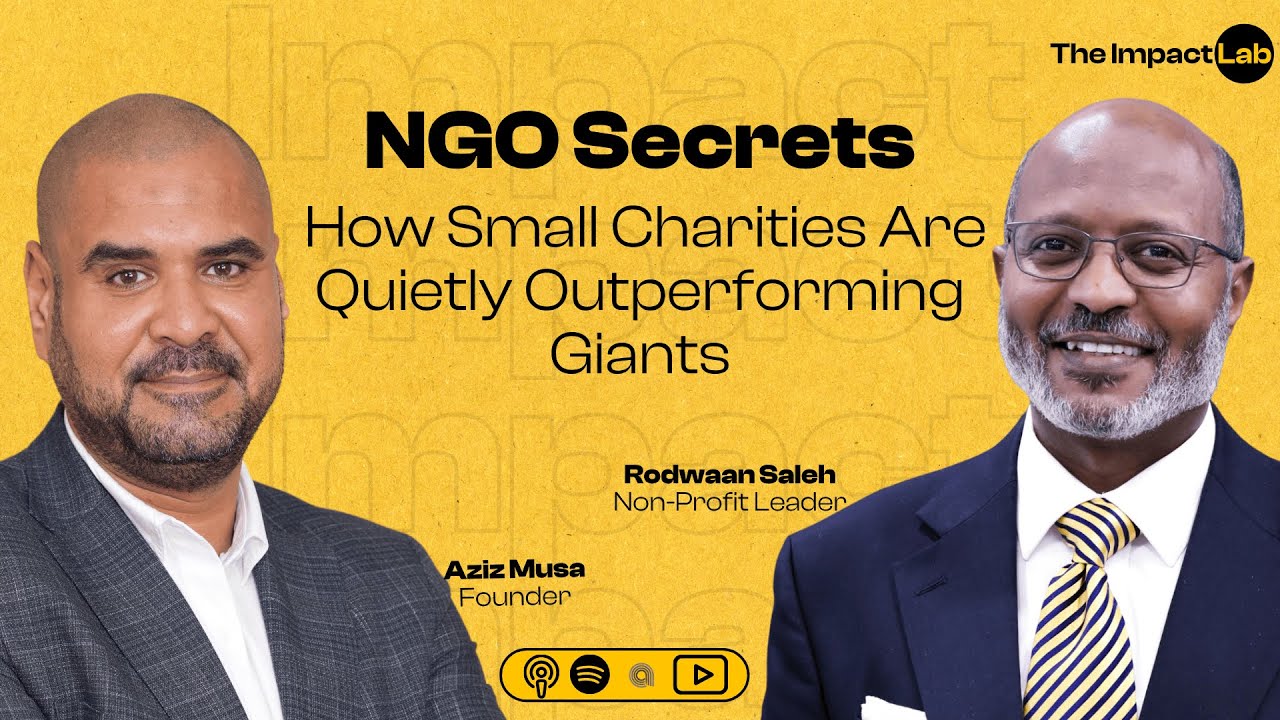
Rodwaan Saleh has spent 25 years working with nonprofits. He explains why small, specialised charities often outperform the giants, and why reporting real numbers is the marketing that keeps donors giving.
Contents
Good charity marketing starts with the programme, not the brand. That is the argument Rodwaan Saleh makes in this episode of The Impact Lab: after 25 years working with nonprofits, as a volunteer consultant and as staff, he has watched small, specialised charities outperform far bigger ones, because they stay close to the people they serve, report real numbers and spend donors' money where donors can see it.
Aziz Musa has seen the other side of it. Cush Digital has filmed charity projects in Sudan, and Aziz says the agency turns down most of the charities that approach it. The two of them work through what separates the organisations worth backing from the ones that are only visible.
Passion is not a plan
Every charity starts with the wish to help. Rodwaan's point is that the wish is not enough. "Any NGO could have a vision to eradicate poverty, but that is so vague." The giants, he says, are separated from everyone else by how meticulously the work is done and whether the impact can be measured.
His example is a village with no power station. A charity arrives and builds a brick school because that is what a school looks like at home. Rodwaan would build it from the material the village's own houses are made of, only bigger, and spend the difference on something that keeps people fed, such as a farming project. Electricity works the same way: with no plant to supply it, the answer is solar panels or small generators, not a grid that will never arrive.
The way to know which is which is to ask. Sit with the community's leaders, get their feedback and win them to the plan, so they own it. "Anytime you have a community that has an ownership, they feel pride in accomplishing something." Aziz names the trap he has seen: a charity brings its home country's assumptions and applies them somewhere they do not fit.
Charity marketing starts with one programme
The habit Rodwaan sees in every successful organisation is focus. If you do education, stick with education, wherever you work. The mistake is to add water, then electricity, then everything else, "this huge pie in the sky." No charity arrives with a magic wand.
That focus is also what makes the money come. He compares a shallow well, which he puts at $3,000 to $5,000 and which can serve a nomadic community passing through for three to five years, with a borehole, a fixed installation serving thousands. Neither is right in general. The data from the ground decides, and then you raise the money for that specific need. Framed that way, he says, "funds will come."
He keeps returning to water, because the cost of not having it is so concrete. Girls who no longer walk miles for water stay home to study. Aziz has seen it himself in the villages of Jebel Marra: girls of ten, eleven and twelve carrying heavy containers up the mountain.
"Glamorous organisations, they're just glamorous... But I oftentimes find organisations that are not even known, they're making a huge impact because they focus on their programme."
Why small charities stretch the dollar further
Rodwaan describes a small charity as a small tool: it does one job precisely. A large organisation is a heavy machine, powerful but expensive to run and slow to turn. Large organisations also work to government standards and fixed policies, including the wages they must pay to qualify for the grants they seek. A small charity can do its own due diligence, find local resources that cost less, and stretch each donation further.
The risk at scale is that the work depends on a few large funders. When that money stops, the project stops, sometimes halfway through a borehole. A small charity with a steady base of sincere donors can keep going, and can still apply for grants when it has projects good enough to win them. Aziz's reading is that every charity starts with the same mission to help, and the bigger it gets, the further its people drift from that mission, until stopping a project becomes a task rather than a loss.
The photo opportunity problem
Asked what charities spend too much on, Rodwaan answers immediately, and pointedly, given who is asking: flashy advertising and branding. Executives who fly in for photographs, post them, fly out, and present it as work. "What actual tangible work have you done?"
Aziz tells a story of his own, without naming the organisation. His team drove eight hours up into Jebel Marra to film a project. The charity's leader paid about $10,000 for a helicopter to make the same trip for the photographs. When they added it up, the filming and the leadership visit together cost double what was spent on the project itself.
He does not conclude that charities should stop marketing. Donors cannot all fly out to see the work, so someone has to show it to them. The question is what that marketing shows.
Reporting is the marketing
For recurring, long-term donations, Rodwaan's answer is one word: reporting. An annual report with real numbers. How many people you served, in which region, under which programme, how many food parcels or medical supplies you delivered. "It cannot be made up, because you will be found out."
He frames donors in two terms charities use: acquisition, winning new donors, and attrition, losing them. Acquisition is the easy part. Attrition is where transparency shows. He recalls an executive at a convention in Chicago who said his organisation spent 55 to 60% of every dollar on operations, and who did not believe Rodwaan's figure of 12 to 18% at the time. In the United States, a registered charity's Form 990 is public, so any donor can look up how much goes to overheads and how much to programmes.
He makes the case that generosity is not the constraint. He puts American giving at $484 billion. That is close to Giving USA's estimate for all US giving in 2021, $484.85 billion, though that total includes foundations, bequests and companies; individuals gave $326.87 billion of it (Giving USA 2022). Either way, the money exists. It goes to organisations that can show what they did with the last donation.
His advice on advertising follows from the same rule: advertise, but tell donors what you spent on it, because it will show up in the accounts anyway. Aziz adds the marketer's version. It is very hard to market something that does not work, and the more of each donation that reaches the ground, the easier the charity is to promote. Reporting is not separate from marketing. It is the most effective part of it.
Where AI fits in a charity
Rodwaan treats AI as a tool, like an autopilot that still needs a pilot. He sees its value in data analysis, faster reporting, and building models in the field instead of waiting to get back to the office. What it cannot do is replace a true story from the field told by the person who saw it. Aziz describes using AI as a sparring partner, which only works if you already have the knowledge to spar with.
The reason for the work
Asked for the moment he knew why he does this job, Rodwaan describes delivering a food box: oil, flour, sugar and tea. The woman who received it asked for two, because her family of seven had made the last one last thirteen days by eating once a day. Then she brought out water and bread for the visitors, and apologised that she could not cook them dinner. "The people with less resources are the most generous."
For anyone who wants a career in the sector, his advice is to start by volunteering, an hour a week with a local organisation that matches what you care about, then use that to build a network of people already doing the work. If you run a charity and want to know whether your marketing is showing the work or only the brand, the sectors we work in and the results we publish show how we approach it.
Questions people ask
What is charity marketing?
Charity marketing is how a charity wins and keeps donors. In this episode, Rodwaan Saleh argues that it starts with the programme, not the brand: a focused programme with measurable results, reported in real numbers, persuades donors better than flashy advertising.
How can a small charity compete with large ones for donations?
By specialising. Rodwaan Saleh says small charities that focus on one programme and stay close to the community can do the work more cheaply and keep going when large funders pull out. Donors who can see where their money went keep giving.
What do donors want to see from a charity?
Transparency. An annual report with real numbers: how many people were served, where, under which programme, and how much went to overheads. In the United States, a registered charity's Form 990 is public, so donors can check.
The two-minute diagnostic shows which pattern your marketing is in
The diagnostic asks nine questions and names the pattern your marketing is stuck in. No call, no pitch, and you get the paper written for that pattern.