
Graduate career advice: don’t wait two years to learn what the market wants
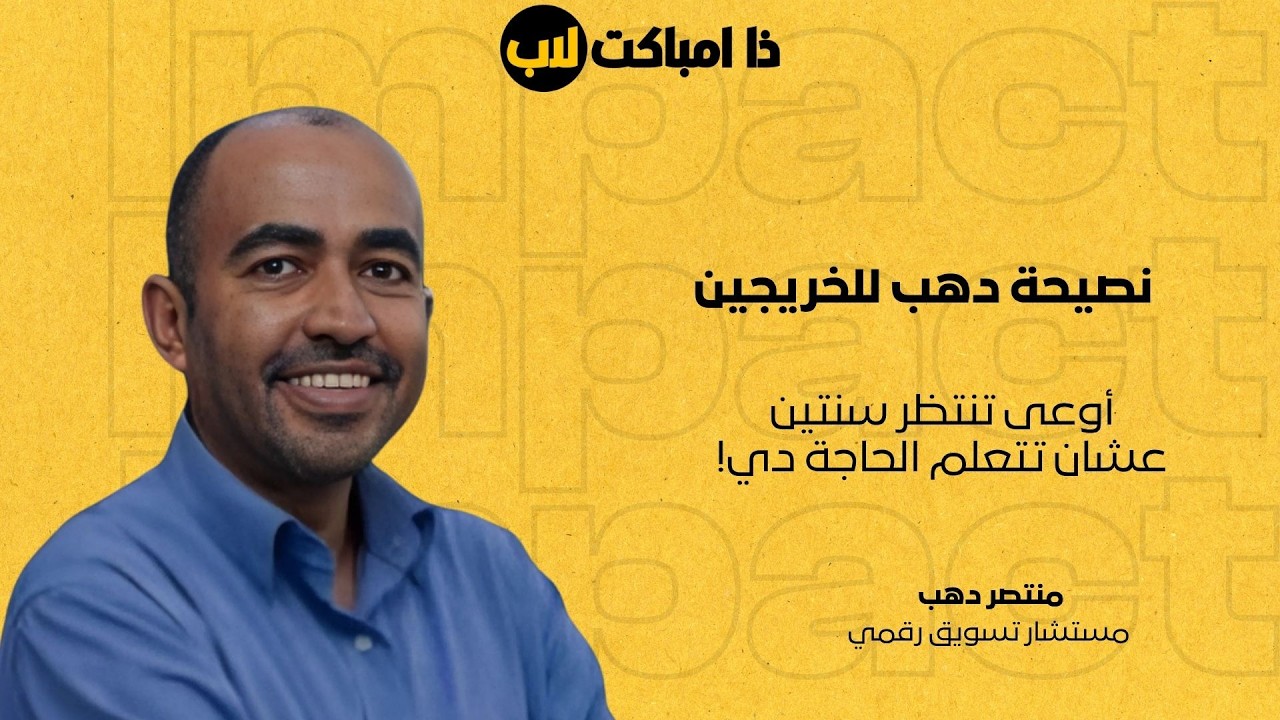
Marketing and business trainer Montassir Dahab tells graduates what the market wants now: AI used properly, communication, showing your work, and a narrow specialism. His advice: do not put it off. The episode is in Sudanese Arabic.
Contents
The best graduate career advice in this episode is that the skills the job market wants do not come with the degree: using AI properly, communicating and presenting yourself and your work with confidence, and specialising in a narrow field. Montassir Dahab, a marketing and business trainer, makes that case in this Arabic episode of The Impact Lab, and tells graduates bluntly not to put it off for two or three years.
Aziz Musa introduces him as one of the people who trained a generation in marketing in Sudan. After the war, Montassir moved to Cairo and went straight back to training, online, because life does not stop and people still need to learn. He now divides his time between Egypt and Saudi Arabia.
What Sudanese entrepreneurs learned in Egypt
Egypt is a mature market that knows its marketing, Montassir says, so the Sudanese who arrived started by supporting one another. Around three years on, he knows young people who started with a table at a small bazaar and now have offices, distribution and Egyptian customers, not only Sudanese ones. Some have set up production houses that now win clients from Saudi Arabia.
Aziz adds that once people accepted they were building lives in Cairo, Luxor or Aswan, they started businesses and hit a problem. In Sudan, he says, people were used to margins of 80 to 150%. In Egypt margins are 5, 6 or 7%, which is normal everywhere else. Montassir agrees: the effort is high and competition fierce, so people learned the value of time, that every minute has a price.
Saudi Arabia is a different market
Montassir calls the Saudi market pivotal, open to the Gulf and to Asia, where global brands set a higher standard. One mistake he saw was people arriving with the Facebook habits they had in Sudan, when in Saudi Arabia the impact is on Snapchat and Instagram.
Influencers there have real reach and authority, he says, and the market is regulated: not everyone with a camera can become an advertiser. Individuals who advertise on social media in Saudi Arabia need a Mawthooq licence, which is mandatory under the rules of the General Authority for Media Regulation.
Aziz says clients everywhere claim their market is different; Saudi Arabia is the one where it really is. He flew to Dubai the day after he graduated; if he graduated today, he says, he would fly to Riyadh. There is more on our work in Saudi Arabia.
Graduate career advice: skills matter more than your degree
Both agree graduates should stop worrying about what they studied. What you should fear, Montassir says, is having no skill; the degree matters far less. Digital marketing in its current form, for instance, will change within a few years. The World Economic Forum's Future of Jobs Report 2025 points the same way: it expects 39% of workers' key skills to change by 2030, with technological skills growing in importance fastest.
AI is already here
Montassir thinks AI will change not only marketing but the way problems are solved. The people who do well will be those who can bend it to their work, not those who rely on it completely. Without skills, he says, you will not compete, however bright you are.
Aziz goes further: AI has already arrived. Five years ago, he says, Cush Digital's office had a large room of designers, twelve or thirteen of them. Today, with the same number of clients, it has three. But he agrees with Montassir on the basic point. If you have the core knowledge, AI makes you a hero. Put rubbish in, and you get rubbish out.
"Don't say you'll wait and learn it in two or three years. That's real advice."
The skills nobody taught
Montassir saw a problem among many Sudanese professionals who left after the war. Their qualifications and experience were strong, but many had never worked in a multinational environment, where presenting yourself and communicating across cultures is a skill in its own right. Some were turned down at interview not for lack of experience, but because their communication fell short and they did not know the working culture of the country they had come to.
Show your work without embarrassment
Sudanese people, Aziz says, are embarrassed to sell themselves or their work; it feels like boasting. But their competition is not in Khartoum or El Obeid any more. It is the whole world, and nobody else hesitates.
Montassir agrees. A CV alone no longer proves anything, so how do you show you have the expertise? Have a portfolio, be present where your field's community gathers, and say plainly: here is the video I made. If someone needs a video made, offer to make it, even for free, so people see what you can do. Some people still wait for the job advert in the newspaper, while someone else got there first by building a personal brand: speaking at forums, posting a video about their area, volunteering, training others.
Aziz tells a story from childhood. He washed cars, and when one neighbour hesitated he offered to wash his car free that week. He learned more, and the neighbour came back. His advice to young people is to be ready to work for free: if they do not pay you in money, they pay you in knowledge, and knowledge matters more.
Pick a niche
A common mistake in building a personal brand, Montassir says, is claiming to know everything. Even within digital marketing, do not say you do digital marketing; say you are strong on Instagram, because people look for the specialist. Aziz takes it one step further: be the Instagram expert for property companies, or for dentists. The narrower your focus, the higher your price, and the clearer the difference you make.
An expert can now compete worldwide, Montassir says. But start at a reasonable price, not $400 or $500 on day one; the demand will follow. Every sector needs marketing, so work with everyone first and specialise later.
The time young people have
A job is a good thing, Montassir says, but your skill and experience are often bigger than the place you work, and you may only realise it later. Young people's advantage is time, and they should use it. Aziz agrees: the trouble is they do not realise that time will narrow later. For more, see the episode on preparing for the 2026 job market and the one on Sudanese success abroad.
Questions people ask
What skills do graduates need for the job market?
Montassir Dahab names three: using AI properly rather than relying on it completely, communicating and presenting yourself and your work in a multinational workplace, and specialising in a narrow field. The job market is a skills market, and your degree subject matters less than graduates think.
How can a graduate prove their skills without much experience?
Show the work. Build a portfolio, be present where your field's community gathers, post videos about your area, volunteer and train others. Aziz Musa also advises being ready to work for free at first: if you are not paid in money, you are paid in knowledge.
Why should a graduate specialise in a niche?
Because people look for specialists, not someone who claims to know everything. Instead of saying you do digital marketing, be the Instagram expert for property companies or dentists. The narrower your focus, the higher your price and the clearer the difference you make.
The two-minute diagnostic shows which pattern your marketing is in
The diagnostic asks nine questions and names the pattern your marketing is stuck in. No call, no pitch, and you get the paper written for that pattern.