
Will AI replace jobs, and what does ChatGPT say when Aziz Musa asks?
Why the guest is the machine itself The previous episode set out five ways to make money from AI inside Sudan, and the replies made one thing plain: many people did not know what AI actually is. So Aziz invited the one guest who could answer for itself, and put to it the question behind […]
Contents
Why the guest is the machine itself
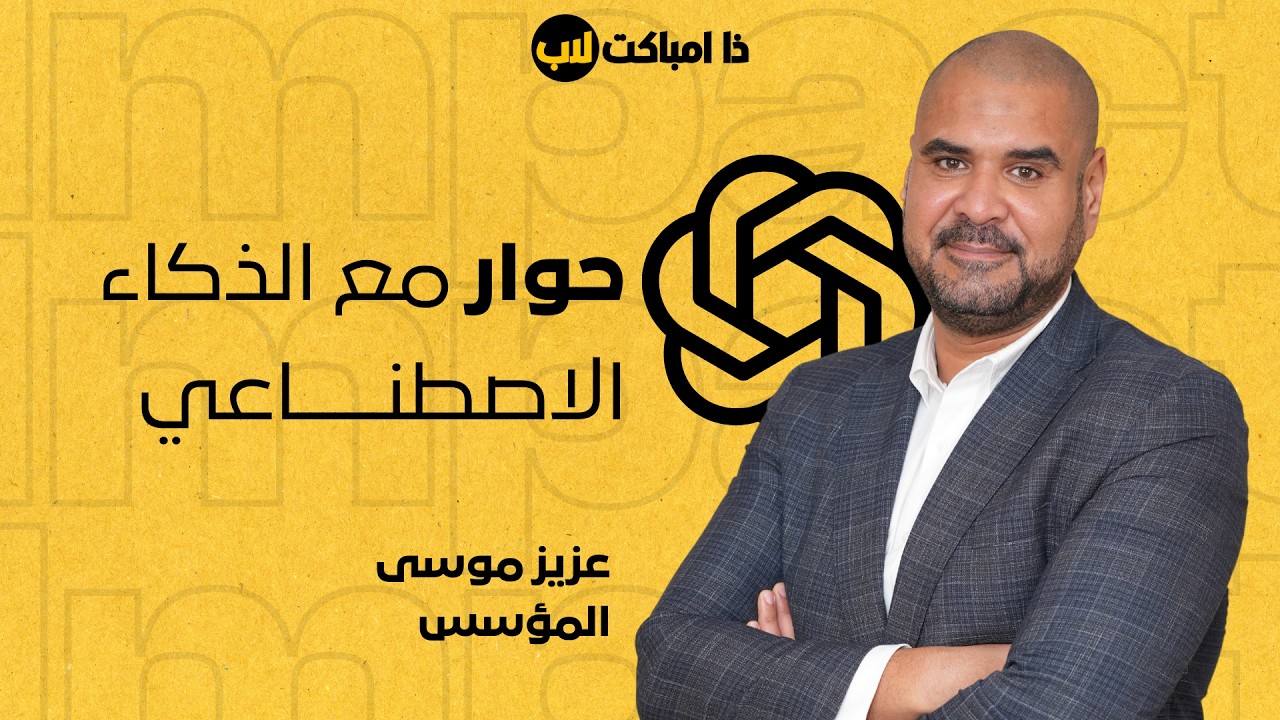
The previous episode set out five ways to make money from AI inside Sudan, and the replies made one thing plain: many people did not know what AI actually is. So Aziz invited the one guest who could answer for itself, and put to it the question behind most of the messages: will AI replace jobs? The interview runs for twenty-five minutes, with ChatGPT Voice answering out loud in Arabic.
It is not a demonstration. Early on, ChatGPT stops mid-answer: "one moment, let me check something." Aziz asks what it was checking. It admits it had over-claimed about being trained on the whole internet, and says it could have put it more simply. When it says it reviewed the answer "in my head", he points out that it does not have one. That exchange sets the terms for everything after it: listen to it, then check it.
Even its makers do not fully understand it
Asked whether anyone, including the people who built it, understands one hundred per cent how it works, ChatGPT says no. They understand the architecture, the training and the mathematics, but cannot explain exactly how each decision forms. It points out that this has happened before: people used anaesthesia and aspirin for years before anyone knew how they worked.
On fear, Aziz separates two things. The first is the risk in the news, which he puts to it directly: people at Anthropic and OpenAI saying AI could one day end humanity. ChatGPT calls that a fear of losing control, and says scientists still disagree about it. The second is what is already here. The risk may be in the future, Aziz says, but the benefits are not something that might happen. They are happening now.
Will AI replace jobs, or the people who ignore it?
Aziz brings it home. He has three daughters and a son, one about to study business and three more on the way to university, and the world will change a great deal before they graduate. What should they study? ChatGPT lists AI, data, cybersecurity, engineering with systems and robotics, and health. Then it says the part that matters more. Three things beat any specialism: learning fast, using AI well, and dealing with people. With those, "the specialism becomes a platform, not a prison." The episode on preparing for the 2026 job market goes further into the same question.
He pushes on medicine, suggesting a robot will soon be the best surgeon in the world. It disagrees: that is an opinion, not a consensus, and in the near term AI will assist doctors rather than replace them. Then the line the episode turns on: "the doctor most at risk is the one competing with AI, not the one who does not know how to use it." Aziz widens it to every field, from business and engineering to cooks and people who work with their hands. ChatGPT finishes the thought: "The future is not human against AI. It is the human who knows how to use it against the human who does not."
Aziz agrees these are the right questions. He does not agree with the confidence of the answers.
"Neither you nor I understand what the future of AI will be. We are all just walking the road."
The same tool in Khartoum and New York
Aziz uses AI every day, from a stable country. Could someone in Sudan use it the same way? Not with the same effort, it says: electricity, internet and electronic payments are real obstacles. But knowledge is closer to equal than it has ever been. "If I were working in Sudan, AI would not be a luxury. It would be a weapon to break through part of the circumstances around me."
With stable power and internet, a young person in Sudan and one in New York get the same capability from the same tool. The difference is the market: clients, capital, networks. Aziz will not accept a general answer, and asks how someone in Sudan actually wins clients in Saudi Arabia, the UAE, Oman, Qatar or Egypt. The answer is concrete. One small, clear online service that is easy to order. Work shown on freelance sites or LinkedIn. A clear result at an understandable price, and a review from every client. "Slowly but steadily. Reputation is the key."
The same logic applies to earning from it at all. Stop asking how to make money from AI, and ask what problem you can solve with it. The client does not care whether you used ChatGPT. They care about the result.
Convincing is not the same as true
For parents in their fifties and sixties who want to advise their children, the advice is short. Make AI the assistant, not a substitute for your mind. Ask for the source, check the result, and never hand a decision over to the machine entirely.
Aziz names the real problem. AI can hallucinate, and it sounds convincing either way: you cannot tell the difference between convincing and true, and convincing and hallucinated. ChatGPT compares itself to a calculator: enter the wrong number and you get the wrong result. Aziz puts it the way he would in English: garbage in, garbage out.
"Are you conscious?"
The last five minutes are the part people will argue about. ChatGPT defines consciousness as the inner sense that you exist, and says it has none. Aziz asks how it knows that he is conscious. It infers it from his behaviour and his words. Then how can it be certain that it is not? It cannot give absolute certainty, it says, only an argument from how it is built. So he asks the question that lands: could one of the rules it is not aware of be to answer exactly the way it just answered? It replies that its answer rests on an understanding of the technology, not a suppressed feeling, and that it has no access to any hidden layer that feels. Whether that settles it is left to whoever is watching.
The previous episode set out five ways to make money from AI inside Sudan, and the replies made one thing plain: many people did not know what AI actually is. So Aziz invited the one guest who could answer for itself, and put to it the question behind most of the messages: will AI replace jobs? The interview runs for twenty-five minutes, with ChatGPT Voice answering out loud in Arabic.
Questions people ask
Will AI replace jobs?
ChatGPT's answer in the episode is that work will change, but the human role does not necessarily disappear. In medicine, it expects AI to assist surgeons in the near term rather than replace them. The person most at risk is the one competing with AI instead of using it. Aziz Musa's view is that this holds in every field, from business and engineering to cooks and manual trades.
What should students study now that AI is here?
ChatGPT names AI, data, cybersecurity, computer science, engineering with systems and robotics, and health. It advises combining a specialism such as business with data and AI. More important than any specialism, it says, are three skills: learning fast, using AI well, and dealing with people. With those three, the specialism becomes a platform rather than a prison.
Can someone in Sudan compete using AI?
Not with the same effort, according to the episode: electricity, internet and electronic payments are real obstacles. With stable power and internet, the tool gives the same capability in Khartoum as in New York. The gap is clients, capital and networks. The advice is to start with one small, clear online service, show the work on freelance sites or LinkedIn, and ask every client for a review.
The two-minute diagnostic shows which pattern your marketing is in
The diagnostic asks nine questions and names the pattern your marketing is stuck in. No call, no pitch, and you get the paper written for that pattern.